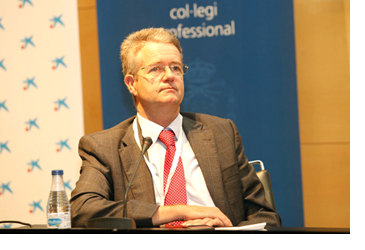
SMEs must not internationalise buying companies, they must do so going for their organic growth

Durante la intervención en la jornadaThe purchase of companies to implement in other markets provokes extra financial costs and a clash between organisations

I have had the opportunity to take part in the Catalonian Telecommunications Diada (National Day), organised each year by the Catalonian College of Technicians and Technical Telecommunications Engineers (COETTC), on a talk together with executives of Vueling, LetBonus, Fundosa and Plasticband, where we analyse the company growth method on a complex environment such as the current one.

The rest of the lecturers belonging to different sectors – Internet, aviation, industrial and services — it is outstanding that all of them coincided on the fact that one way to face the crisis is close management, controlling all details, to be able to introduce improvements in all circuits and to adjust costs as a result of the rationalisation and introduction of innovations in production. Quality is the key for a company to leave crisis and to start a growth stage.

Nowadays, internationalisation is a way of escaping for companies.

In Spain, many people believe that only companies from countries in crisis, such as the ones of the South of Europe, have headed for internationalisation, taking advantage of the improvement of competitiveness due to reduction of labour costs. Nothing could be further from the truth, in Germany, companies have launched into the tackling of Russian and Asian markets as a commitment to the future.

Internationalisation is not a cheap process, neither in time, nor in money, and results are not immediate. On the other hand, internationalisation by means of the purchase of companies is not always a success, especially for familiar SMEs. As for the internationalisation by the acquisition of companies, it is complex because it implies adding to the complexity of the process, a merging of different business cultures.

In acquisitions, on most occasions, staff of the acquired company falls into the binomial of discouragement and demand of labour and monetary improvements. Organic growth is much healthier and does not oblige to an extra financial effort by the purchasing company.

Thus, companies that internationalise must go for contracting local staff of the country in which they are implemented, but also staff from the countries with which they are going to have relationships; clients grow and their loyalty is encouraged if you talk to them on their same language. In order for a German, Spanish, Chinese company or company from any other country to triumph abroad, we must have the idea that it is a local company which is going out to the external market.

(Español) “La clave para hacer negocios en Rusia”: Artículo en el diario Expansión sobre la Semana Rusa de Gild International

articulo_expansion

“Russian and Spanish: business in a private club”, the Russian Week at Gild International in the Media

During the presentation of the Russian Week at Gild International I had the pleasure of being interviewed by Manel Manchon of Economía Digital.

Marc Ambrock, the German businessman and President of Gild International, is a huge advocate for companies to internationalize. Manuel Manchón 25/05/2013

Marc Ambrock during the presentationAmbrock is a German businessman who has deep roots in the business practice, ethics, and values that have made large German enterprise one of the world’s largest and most thriving economies. His family business, Ambrock group, has been in international business for 125 years. Ambrock now runs other projects like Adminex, which he founded to help the internationalization of the small and medium size enterprise.

This is his passion. Ambrock has lived in Barcelona for 20 years, but travels constantly. His wife is Catalan, and that fusion is fundamental to Ambrock. “No German would touch his arm to his interviewer, Mark distances,” he says, after doing the same with this reporter.

And that extroversion, which is also the sign of a security for his work and for all that he believes, has led to another project that he dedicated his body and soul to. Ambrock has revitalized the private business club Gild International, which was launched in 2007 in the Eixample of Barcelona, but over the past two years, has gained full force.

German Persistence

This is the club where you do business. An exquisite gourmet restaurant pampers its guests; there are multiple meeting rooms of different sizes, and the overall cozy atmosphere is very different from a large hotel or offices of political institutions and businesses.

In a small palace in the charming and paved passage Permanyer, Russian and Spanish professionals exchanged views this past week. A platform dedicated to Russia, with the momentum of Ambrock.

“The Germans have already been in Russia for years, and while they have had many failures, they are persistent, and that is the best feature that an entrepreneur can have who wants to internationalize” says Ambrock.

No public contests

In the club, we provided a platform that that clashed with the norms of the highly competitive business and professional world. In Russia, there are “no public contest” for innovative projects and ideas. One of the biggest factors in internationalizing is to be sure “you know, you establish a personal connection”. Therefore afterwards, an entrepreneur can have access into certain circles where decisions are ultimately made. This takes time, and constant travel, says Ambrock.

Russia is now emerging as a huge market, “because it is a continent with a growing middle class,” said the German businessman.

Increased exports

During Russian Week, the project director of Invest in Spain, Mercedes Pizarro, spoke of the Russian sin of neglecting many areas of the economy, but energy efficiency however, is the true Russian manna. Furthermore, there are many Catalan Natural Gas companies that are already present in Russia.

In addition, Russia and Spain signed an agreement that has facilitated trade and grown exports to Russia by 47% over the past two years. The turnover has grown from 1.994 million euros in 2010 to 3000 million in 2012, according to the Ministry of Economy.

Russian Tourists

What else is in Russians interests? For now tourism. The tour operator Natalie Tours Catalunya brings each year nearly half a million of Russian tourists, one of the most important sources of wealth in these times of economic crisis. Those tourists, however, can be clients of other sectors as well, because they also seek business opportunities in Catalonia and Spain, as noted Ambrock.

The exchange of knowledge in private clubs, which have always existed, is now more valuable than ever; especially with many governments in an agonizing situation and few ideas to stimulate the economy.