Category Archives: International management

Europe on the rebound

After six years of crisis, Europe is back; slowly so, but back. The euro has survived, the first structural measures have been implemented, the economic indicators are showing a light growth for next year and trust is quietly recovering. Not that all is now resolved, but…

The situation in the fast-growing emerging countries is not what many businesses from these markets were hoping for either. First, because these markets also need time for their development; second, because they too have to consolidate their growth; and third, there as anywhere else, is not all just about free trade. In short, there as well, all that glitters is not gold.

In the so-called BRIC countries, and for a series of reasons, any kind of production is not exactly made simple: trade barriers, poor quality of produced goods, just-in-time delivery made unrealistic by long delivery channels, some corruption, and last but not least, cultural barriers which greatly raise costs and do not match the immense expectations of the end client. As a result, many businesses are find themselves attracted again by Europe’s relative political and economic stability. On these grounds, Europe is considered the lesser evil.

Simultaneously America’s economy is rising; a country which has always been closer to Europe for cultural reasons, trusts more its institutions and also prefers to build on the long-standing connections with the Old Continent.

Even the Asian economy is leaning more towards Europe, in part conditioned by weakened exchange rates – like in India’s case – and in part by strategic reflections. This demonstrates that some of the old European industries are still setting the standards for the rest of the world. However, Europe also shows a divide, especially in regards to investors.  On the one side, there are solid industries, infrastructures and reliable institutions in Central Europe, on the other side, you see weakening states with less productivity, mostly in the South.

In our context of shrinking margins and higher cost pressure, these arguments weigh twice as much. That leads, in my view, to a London-Frankfurt-Zürich axis, where and which determines the central decisions and which the non-European investors also have to turn to. We will have to face these changes, whether we like it or not.

Yes, I do believe that Europe is coming back but I also think that so will the crisis if we don’t push for more reforms. Unfortunately at the moment, Mrs. Merkel is setting a rather poor example. For all that, and as a precaution, I am preparing myself for a long-lasting crisis, that is, for lasting and quick changes in the market circumstances.
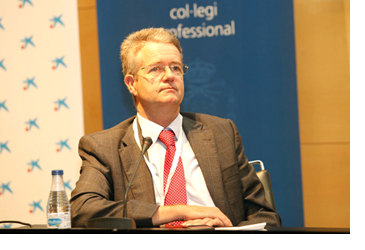
SMEs must not internationalise buying companies, they must do so going for their organic growth

Durante la intervención en la jornadaThe purchase of companies to implement in other markets provokes extra financial costs and a clash between organisations

I have had the opportunity to take part in the Catalonian Telecommunications Diada (National Day), organised each year by the Catalonian College of Technicians and Technical Telecommunications Engineers (COETTC), on a talk together with executives of Vueling, LetBonus, Fundosa and Plasticband, where we analyse the company growth method on a complex environment such as the current one.

The rest of the lecturers belonging to different sectors – Internet, aviation, industrial and services — it is outstanding that all of them coincided on the fact that one way to face the crisis is close management, controlling all details, to be able to introduce improvements in all circuits and to adjust costs as a result of the rationalisation and introduction of innovations in production. Quality is the key for a company to leave crisis and to start a growth stage.

Nowadays, internationalisation is a way of escaping for companies.

In Spain, many people believe that only companies from countries in crisis, such as the ones of the South of Europe, have headed for internationalisation, taking advantage of the improvement of competitiveness due to reduction of labour costs. Nothing could be further from the truth, in Germany, companies have launched into the tackling of Russian and Asian markets as a commitment to the future.

Internationalisation is not a cheap process, neither in time, nor in money, and results are not immediate. On the other hand, internationalisation by means of the purchase of companies is not always a success, especially for familiar SMEs. As for the internationalisation by the acquisition of companies, it is complex because it implies adding to the complexity of the process, a merging of different business cultures.

In acquisitions, on most occasions, staff of the acquired company falls into the binomial of discouragement and demand of labour and monetary improvements. Organic growth is much healthier and does not oblige to an extra financial effort by the purchasing company.

Thus, companies that internationalise must go for contracting local staff of the country in which they are implemented, but also staff from the countries with which they are going to have relationships; clients grow and their loyalty is encouraged if you talk to them on their same language. In order for a German, Spanish, Chinese company or company from any other country to triumph abroad, we must have the idea that it is a local company which is going out to the external market.

France or Dubai

It was only recently that a client called me, asking for support in his export activities as he had some problems.  Quite pleased with myself, I confirmed that I am indeed responsible for export solutions and would assist him with pleasure. Disillusion followed instantly, as the client spelt out to me that he would need support in France, Dubai, Algeria and Nicaragua.  With the counter question: What experience do you already have of those countries? I won myself enough time to recover from my surprise and swore never again to promise too much too soon. The client has only two subsidiaries in Europe I remembered vividly and asked myself tensely, whether I was dealing with a proper strategy for expansion, delusions of grandeur or simply an overestimation of  the company’s own capacities.

No, he answered, he hadn’t any experience of those markets, but he had serious inquiries, even if so far he had only been to France for holidays. But without doubt, he added, the future lies in a strategy for internationalization, as wasn’t it true that there wasn’t much to gain in national markets anymore? Correct as his analysis was, I slowly started to realize that I had to carefully explain to the client that he would have to concentrate on just ONE new market first, and for his own good, a relatively close one.

So I started my next question by asking whether he or his management team spoke French, Spanish or Arabic, a fact which he shouldn’t belittle. A further question of who he would contract as regional managers within these countries, brought him back to reality, and now the client asked me with disarming honesty: What do you think: France or Dubai?

No question. Even for a larger European SME, France is an important market not to be overlooked, but the risk can also be easily overlooked, without even thinking about cultural differences. Consider that France is a European neighbour with many peculiarities and endless possibilities for failure, if one does not respect local market characteristics.